Fighters
1: Posthumously marry the foes they kill, to mollify their wrathful ghosts.
2: Wear live toxic creatures in vessels like kettles. When a weapon needs coating, they press on the kettles’ covers to crush the creatures and produce a dose of poisonous slurry.
3: Replace their teeth with serrated metal dentures as a weapon of last resort.
4: Are expected to seal their hands away in things like thick thumbless mittens when in the company of people who haven’t killed before.
5: Believe that to look into a dying man's eyes is to invite death upon oneself, and so kill from as far away as possible.
6: Know the tournament list by heart, each accounted for in their own ranking. To the highest goes the prize of a magic sword which obeys only the unrivaled victor.
Wizards
1: Paint their brows with the juices of bioluminescent fish dredged up from the depths, so as to have a source of light that won’t risk igniting delicate pages.
2: Since time immemorial have recorded their spells in the very land as enormous geoglyphs, readable only from the highest towers, which the wizards compete to build and sabotage.
3: Learn their art at the feet of inhuman beings that dream trapped twixt the roots of rotting trees, taking on apprentices to pass on the debt demanded by this learning so it doesn't dog them into the hereafter.
4: Maintain a complex parallel cuisine based on the capture and consumption of their enemies' familiars.
5: Have been expelled based on a rather credible prophecy.
6: Wear cages around their heads to keep the spells from getting out. It’s a matter of sectarian violence as to whether these cages should be heavy and barbed to most discourage escape, or gilded and silk-cushioned to encourage stay.
Thieves
1: Have all had their names stolen from them, and go by obtuse titles instead, like Lily-Foot and whatnot.
2: Pierce holes down the side of their throats from which they can produce a secretive whistle-language, covering them with a scarf or flesh-toned clay when not in use.
3: Are promised a pardon for all their crimes if they manage to steal the king's stomach back from the rogue royal alchemist.
4: Are raised as such from orphanhood, bought and tossed into a hallucinogenic maze. Those who survive and escape are inducted into their obscure order. Those who survive but do not escape degenerate into things like pale, fungal minotaurs.
5: Rumour of the ultimate prize of their sort: the crown of the unking, law-giver to the lawless.
6: Keep smuggling routes crisscrossing beneath the land, built out from the sapping tunnels of an old war.
Clerics
1: Imbibe an entheogen distilled from the ecstatic tears of anchorites, which gradually crowds their sockets with eyes.
2: Wrestle with the sacred animals of other religions to prove the superiority of their own faith.
3: Enjoy an inchoate charisma among the common folk, and can rile up a rabble with a few minutes of preaching, the fierier and brimstonier the better.
4: Denote their doctrine by the magnificent size and decoration of their hats.
5: Advance through their ranks by means of novel exegesis, rewarded for both mystic insight and politically convenient interpretation.
6: Are bound to use the blood they spill to paint the lips of their idols, and so tend to prefer either blunt and strangling weaponry or to build idols into the hilts of their blades.
Druids
1: Are civilization's slave-breakers, living on the rim of rural life and forging the wilds into pastoral utility.
2: Keep the soft, uncalloused skins they shed when they fled into the wilds, to cloak themselves in an urbane guise when they stalk the cities.
3: Plant seeds in the flesh to grow thorns, barky armour, and suchlike.
4: Resort to a form of gu in times of great crisis. A druidic circle will seal itself within a cave, and the druid who survives and devours the rest will emerge swollen with their power.
5: Enact the last, simple wishes of the animal dead, the casualties of nature's red teeth and claws, so that their spirits may cycle out of stagnation.
6: Are advocates of a natural democracy, giving voice to the needs of the smallest and most populous sorts of life (which more often than it might seem leads to plague-spreading and verminous hordes).
Paladins
1: Defend peasant communes where land and property is held in common.
2: Fight in tandem with a guardian angel bound to them by gossamer chains.
3: Find each other by way of guiding stars that only the inspired can see.
4: Are believed to reincarnate, and after one’s death their successor is found by searching for the child whose grip on their sword matches theirs in life.
5:Wear dog-masks with the muzzles stuffed with fragrant herbs, both to avoid inhaling heathen airs and to display their status as sheepdogs of the shepherd of mankind.
6: Experience revelatory visions by lying in a pit of mirrors at noontide until they get sunstroke.
Bards
1: Fear and covet the music of the secret sphere, the nemesis-planet Nibiru, which whispers through in the laments of the suicidal and the screams of the war-maddened.
2: Threaten ungenerous patrons with an instrument that, if tuned just right, whips out with a coiled steel string that cuts like a razor.
3: Harbour a heresy that seeks the perfect coda for the universe, a chorus to cancel out "Let there be light".
4: Strain under the puritanical prohibition of all music but hymns.
5: Steal inspiration from the birds with draughts of diluted dragon-blood that grant them snatches of understanding of the avian tongue.
6: Are served by creatures like backwards bats, that project fleshy feelers from their sound-based true forms. Only true bards know how to strum the addictive tones that command them.
Monks
1: Seek to disrupt the demiurge's illusions by striking vital points and creatures in its creation.
2: Practice a sort of alchemy which uses their own bodies as vessel and crucible.
3: Literally shadowbox, as their shadows are seen as a source of impurity and so severed and imbued with an antagonistic intelligence as part of their training.
4: Believe that enlightenment can be found at the root of the cosmos, and so when they grow too old or too ambitious to linger they venture down into the depths.
5: Are in the middle of a miniature civil war between the staid traditionalist styles and a charismatic cult of maximally efficient violence.
6: Act like a sort of philosophically-driven vice squad that cracks down on what they see as impurity in the body politic.

Thursday, November 14, 2019

Wednesday, November 6, 2019
20 Miscellaneous Magic Items
1. Poppet Pipe: Shaped like a grotesquely stretched little man with his ankles beside his ears, his gaping maw the bowl and his narrow bum the lip. When a part of a creature is smoked in the pipe, the smoker gains insight into their condition and location based on how big the part was. A few strands of hair might produce a body load reminiscent of the creature's level of health and injuries. A fistful of the same might grant feverish glimpses of the creature's surroundings, and an intimate experience of their strengths and weaknesses.
2. Emboweling Forceps: A toothy forceps that looks more like it belongs in a torture chamber than an emergency room. When used to close a wound, the forceps negate the damage dealt by that wound, and transforms it into a mouth. If someone with a wound closed by the forceps takes other damage, the damage which the forceps negated returns. This also occurs if they have a different wound closed by the forceps.
Until the damage the forceps negated is healed by other means, the mouth it leaves will (1d4):
1: Develop a voracious appetite, and require its own share of rations.
2: Mutter its bearer's secret intentions.
3: Shriek at inopportune moments, ruining any chances its bearer has of surprise.
4: Nip at nearby flesh while its bearer is asleep, having a 4-in-6 chance of ruining an otherwise good full rest.
3. Carcerian Arrows: Arrows with shafts of dusty stone, and forked iron heads. When more than one Carcerian arrow is shot in an area, they'll sprout chains that link between themselves and bind around the spots they're embedded in. Come in bundles of 1d4+1.
4. Planar Suspender: A lead disk inscribed with mathematical formulae, and four articulated claws around its rim. On its back is a triangular switch with three possible positions. When the planar suspender is attached to an object, that object is locked into its position on one of the spatial planes, depending on the setting of its switch. For example, if the planar suspender is set in the first position, the object it's attached to can be moved side to side, and forwards and backwards, but not up or down, and so on and so on.
5. Cardial Caesura: A disembodied heart with its ends capped off by amber plugs. Can be "primed" by pumping it, which gets it beating on its own, at a rate synced up to the heartbeat of the person holding it. After 1d4+2 rounds, the caesura stops beating again, and in the process stops the heart of the person holding it when it does.
6. Claustrophobomb: A light aluminum sphere with the impressions of hands pressing out from within. When given a hard squeeze, a claustrophobomb will shortly thereafter detonate, causing a localized spatial implosion. Within an enclosed space, like a dungeon room, the space will decrease by a quarter of its full size each round. After four rounds, the space will have diminished to nothing, and the surrounding area will contract inwards around the diminished space as though it never existed. Anything within the space after four rounds is crushed and destroyed. Exits from the space (windows, doorways, etc.) maintain their full size throughout. If detonated outdoors, the claustrophobomb will release some disturbing distortions, but otherwise have no effect.
7. Ghosttallow Candle: A candle made from something between blue smoke and wax. Within the reach of this candle’s light, transparent and translucent materials become intangible to opaque materials, and opaque gases and liquids act as solids with the hardness of wood. A randomly found candle is big enough to be lit for 1d6*10 minutes, or lit at both ends for half that duration and twice the area of effect.
8. The Sail of Seaworthiness: A white linen sail always followed by a gentle breeze that smells of the sea. Anything the sail is attached to behaves in the water as though it were a sailboat, with comparable buoyancy, speed, and maneuverability.
9. Omicron Exinda: A metallic orange object shaped like a pyramid with its top third lopped off, etched with sigils. When activated, the Omicron Exinda will reverse time by one hour. The activator and everything they interacted with during that hour will retain full memory of what transpired during it. Single-use.
10.The Rat King's Crown: A crown of lumpy gold and long, sharp incisors. Whoever wears it is recognized as the true king of rats, above any tail-tied imitation. However, the king has been gone a long time, and much of their authority has waned. The wearer is able to speak with rats, and can ask favours of them that don't take more than a day to complete or put them in harm's way. The wearer can also hire swarms of rats as a hirelings, paying them in rations and pretty trash rather than coins. Each swarm counts as a single hireling. Over time the wearer might build back up their kingdom, and all the prestige and loyalty that comes with it.
11. Mask of the Beautiful Ones: Immaculate white porcelain with ruby-red lips bowed in a coy smile. When placed upon one's face the mask fuses to the skin beneath, taking on the appearance of living flesh, though its expression never wavers. The wearer no longer needs to eat or drink, and they gain advantage on reaction rolls with any intelligent humanoids. However, any positive reactions gained with the mask are tainted, turn ugly, and those influenced by it will come to want to possess the wearer.
12. Omnisponge: A shiny black sponge with holes that seem to go far deeper than the sponge's size would make possible. The omnisponge can soak up up to 1,000 cubic feet of liquid. Liquid soaked up by the omnisponge is effectively massless, and remains in stasis in the state it was in when soaked up. The bearer of the omnisponge can choose which and how much liquid is released when they squeeze it. While the omnisponge can't be harmed by liquids (or indirect harms coming from those liquids, e.g. the heat coming off lava), it's as vulnerable as an ordinary sponge to other sources of harm. If the omnisponge is damaged it immediately releases all the liquid it's got soaked.
13. Boring Hole: Looks like a hoop of barbed wire, but the barbs are tiny drills. When placed against a surface and activated, the boring hole will create a tunnel1d6x1d6x10 feet deep, with open space using up depth but not otherwise blocking the tunneling. If placed against a creature, which must be unconscious or otherwise immobilized, the hole will do 6d6 damage. Believed to be the result of a mistreated and spiteful portable hole.
14. Canny Knocker: A coppery-green door knocker without a door, bearing the face of a grinning satyr. If placed against a magically sealed portal and knocked, the canny knocker will open it, though only for a round, and only once on any given portal, making each trip one-way. Besides physical portals, the canny knocker can also be used on the faint traces left behind by teleportation, gate, and similar spells, opening a portal for a round that leads to their destination. It has no effect on portals sealed by mundane means.
15. God-Image Prism: A prism that glimmers with indescribable colours, made by heretical scholars to refract the image of God in which one was made. If you use it you can rearrange the distribution of your stats and change your class to another at the same level. Forever afterwards divine magic can't heal you, and stepping on holy ground causes you to burst into flames. Can only be used once per person.
16. Ultimate Bait: A little clay pot with a faintly irresistible scent. It bears the seal of the fisherman-god. If uncorked or shattered, immediately and simultaneously trigger every wandering monster encounter on the local encounter table.
17.The Bladder of St. Elbari: A shriveled and vaguely smelly thing like a raisin the size of your fist. A leather sling is strung through it. While you wear the bladder you cannot die of suffocation. When you pass out from lack of oxygen, you wake up in the nearest space with breathable air, or wash up on the nearest shore if in a body of water (or other fluid).
18. Gargantua Serum: A syringe full of viscous yellow fluid. A randomly found syringe contains 1d4 doses. If injected into a human or demihuman, they transform into a gigantic version of themself (stat as hill giant) in a burst of rapidly growing tissue. Roll 2d6:
On a 2: They immediately go berserk, attacking and attempting to eat the nearest living thing. If they can't perceive any living things, they tear up their surroundings instead. The transformation and berserk state are permanent.
On a 3-5: They immediately go berserk as above. The transformation lasts 3d6 rounds, and then their normal self reforms in the swiftly-decomposing flesh of their giant body.
On a 6-8: They retain control over themself for 1d6 rounds, then go berserk for another 2d6 rounds after that, if they don't deliberately end the transformation while they're in control.
On a 9-11: They retain control over themself for 2d6 rounds, then go berserk for another 1d6 rounds after that, if they don't deliberately end the transformation while they're in control.
On a 12: They retain control over themself for 3d6 rounds, and then their normal self reforms in the swiftly-decomposing flesh of their giant body.
If the viscous fluid is consumed rather than being injected, the consumer transforms into an even bigger version of themself (stat as mountain giant, or whatever the biggest available giant in your system of choice is), and immediately and permanently goes berserk as though a 2 were rolled.
19. The Bell of Faithful Hans: A lead bell with a horse leather-wrapped handle that rings a deep, clattering note. When rung, a horse appears within ten feet, from behind an obstacle if possible. It is the same horse every time: Hans, a piebald stallion. Hans is exceptionally loyal and obedient for a horse, but generally ordinary otherwise. If Hans is killed and his bell is rung again, he will appear in an undead state still bearing the wound(s) that killed him, and still loyal to the one who rang it. The only way to prevent Hans from coming when his bell is rung is to completely destroy his skeleton.
20. Anagrammatogenesis Sludge: A vat full of stuff that looks like Enochian alphabet soup. Toss in up to three items, then rearrange the letters that make up their names into the name of a new item. If you can do this in less than a minute real-time, the sludge morphs into that new item, consuming the items tossed in in the process. If you take longer the sludge explodes for 6d6 damage to everything within 30 feet, and amalgamates whatever it kills into a hideous chimera.
2. Emboweling Forceps: A toothy forceps that looks more like it belongs in a torture chamber than an emergency room. When used to close a wound, the forceps negate the damage dealt by that wound, and transforms it into a mouth. If someone with a wound closed by the forceps takes other damage, the damage which the forceps negated returns. This also occurs if they have a different wound closed by the forceps.
Until the damage the forceps negated is healed by other means, the mouth it leaves will (1d4):
1: Develop a voracious appetite, and require its own share of rations.
2: Mutter its bearer's secret intentions.
3: Shriek at inopportune moments, ruining any chances its bearer has of surprise.
4: Nip at nearby flesh while its bearer is asleep, having a 4-in-6 chance of ruining an otherwise good full rest.
3. Carcerian Arrows: Arrows with shafts of dusty stone, and forked iron heads. When more than one Carcerian arrow is shot in an area, they'll sprout chains that link between themselves and bind around the spots they're embedded in. Come in bundles of 1d4+1.
4. Planar Suspender: A lead disk inscribed with mathematical formulae, and four articulated claws around its rim. On its back is a triangular switch with three possible positions. When the planar suspender is attached to an object, that object is locked into its position on one of the spatial planes, depending on the setting of its switch. For example, if the planar suspender is set in the first position, the object it's attached to can be moved side to side, and forwards and backwards, but not up or down, and so on and so on.
5. Cardial Caesura: A disembodied heart with its ends capped off by amber plugs. Can be "primed" by pumping it, which gets it beating on its own, at a rate synced up to the heartbeat of the person holding it. After 1d4+2 rounds, the caesura stops beating again, and in the process stops the heart of the person holding it when it does.
6. Claustrophobomb: A light aluminum sphere with the impressions of hands pressing out from within. When given a hard squeeze, a claustrophobomb will shortly thereafter detonate, causing a localized spatial implosion. Within an enclosed space, like a dungeon room, the space will decrease by a quarter of its full size each round. After four rounds, the space will have diminished to nothing, and the surrounding area will contract inwards around the diminished space as though it never existed. Anything within the space after four rounds is crushed and destroyed. Exits from the space (windows, doorways, etc.) maintain their full size throughout. If detonated outdoors, the claustrophobomb will release some disturbing distortions, but otherwise have no effect.
7. Ghosttallow Candle: A candle made from something between blue smoke and wax. Within the reach of this candle’s light, transparent and translucent materials become intangible to opaque materials, and opaque gases and liquids act as solids with the hardness of wood. A randomly found candle is big enough to be lit for 1d6*10 minutes, or lit at both ends for half that duration and twice the area of effect.
8. The Sail of Seaworthiness: A white linen sail always followed by a gentle breeze that smells of the sea. Anything the sail is attached to behaves in the water as though it were a sailboat, with comparable buoyancy, speed, and maneuverability.
9. Omicron Exinda: A metallic orange object shaped like a pyramid with its top third lopped off, etched with sigils. When activated, the Omicron Exinda will reverse time by one hour. The activator and everything they interacted with during that hour will retain full memory of what transpired during it. Single-use.
10.The Rat King's Crown: A crown of lumpy gold and long, sharp incisors. Whoever wears it is recognized as the true king of rats, above any tail-tied imitation. However, the king has been gone a long time, and much of their authority has waned. The wearer is able to speak with rats, and can ask favours of them that don't take more than a day to complete or put them in harm's way. The wearer can also hire swarms of rats as a hirelings, paying them in rations and pretty trash rather than coins. Each swarm counts as a single hireling. Over time the wearer might build back up their kingdom, and all the prestige and loyalty that comes with it.
11. Mask of the Beautiful Ones: Immaculate white porcelain with ruby-red lips bowed in a coy smile. When placed upon one's face the mask fuses to the skin beneath, taking on the appearance of living flesh, though its expression never wavers. The wearer no longer needs to eat or drink, and they gain advantage on reaction rolls with any intelligent humanoids. However, any positive reactions gained with the mask are tainted, turn ugly, and those influenced by it will come to want to possess the wearer.
12. Omnisponge: A shiny black sponge with holes that seem to go far deeper than the sponge's size would make possible. The omnisponge can soak up up to 1,000 cubic feet of liquid. Liquid soaked up by the omnisponge is effectively massless, and remains in stasis in the state it was in when soaked up. The bearer of the omnisponge can choose which and how much liquid is released when they squeeze it. While the omnisponge can't be harmed by liquids (or indirect harms coming from those liquids, e.g. the heat coming off lava), it's as vulnerable as an ordinary sponge to other sources of harm. If the omnisponge is damaged it immediately releases all the liquid it's got soaked.
13. Boring Hole: Looks like a hoop of barbed wire, but the barbs are tiny drills. When placed against a surface and activated, the boring hole will create a tunnel1d6x1d6x10 feet deep, with open space using up depth but not otherwise blocking the tunneling. If placed against a creature, which must be unconscious or otherwise immobilized, the hole will do 6d6 damage. Believed to be the result of a mistreated and spiteful portable hole.
14. Canny Knocker: A coppery-green door knocker without a door, bearing the face of a grinning satyr. If placed against a magically sealed portal and knocked, the canny knocker will open it, though only for a round, and only once on any given portal, making each trip one-way. Besides physical portals, the canny knocker can also be used on the faint traces left behind by teleportation, gate, and similar spells, opening a portal for a round that leads to their destination. It has no effect on portals sealed by mundane means.
15. God-Image Prism: A prism that glimmers with indescribable colours, made by heretical scholars to refract the image of God in which one was made. If you use it you can rearrange the distribution of your stats and change your class to another at the same level. Forever afterwards divine magic can't heal you, and stepping on holy ground causes you to burst into flames. Can only be used once per person.
16. Ultimate Bait: A little clay pot with a faintly irresistible scent. It bears the seal of the fisherman-god. If uncorked or shattered, immediately and simultaneously trigger every wandering monster encounter on the local encounter table.
17.The Bladder of St. Elbari: A shriveled and vaguely smelly thing like a raisin the size of your fist. A leather sling is strung through it. While you wear the bladder you cannot die of suffocation. When you pass out from lack of oxygen, you wake up in the nearest space with breathable air, or wash up on the nearest shore if in a body of water (or other fluid).
18. Gargantua Serum: A syringe full of viscous yellow fluid. A randomly found syringe contains 1d4 doses. If injected into a human or demihuman, they transform into a gigantic version of themself (stat as hill giant) in a burst of rapidly growing tissue. Roll 2d6:
On a 2: They immediately go berserk, attacking and attempting to eat the nearest living thing. If they can't perceive any living things, they tear up their surroundings instead. The transformation and berserk state are permanent.
On a 3-5: They immediately go berserk as above. The transformation lasts 3d6 rounds, and then their normal self reforms in the swiftly-decomposing flesh of their giant body.
On a 6-8: They retain control over themself for 1d6 rounds, then go berserk for another 2d6 rounds after that, if they don't deliberately end the transformation while they're in control.
On a 9-11: They retain control over themself for 2d6 rounds, then go berserk for another 1d6 rounds after that, if they don't deliberately end the transformation while they're in control.
On a 12: They retain control over themself for 3d6 rounds, and then their normal self reforms in the swiftly-decomposing flesh of their giant body.
If the viscous fluid is consumed rather than being injected, the consumer transforms into an even bigger version of themself (stat as mountain giant, or whatever the biggest available giant in your system of choice is), and immediately and permanently goes berserk as though a 2 were rolled.
19. The Bell of Faithful Hans: A lead bell with a horse leather-wrapped handle that rings a deep, clattering note. When rung, a horse appears within ten feet, from behind an obstacle if possible. It is the same horse every time: Hans, a piebald stallion. Hans is exceptionally loyal and obedient for a horse, but generally ordinary otherwise. If Hans is killed and his bell is rung again, he will appear in an undead state still bearing the wound(s) that killed him, and still loyal to the one who rang it. The only way to prevent Hans from coming when his bell is rung is to completely destroy his skeleton.
20. Anagrammatogenesis Sludge: A vat full of stuff that looks like Enochian alphabet soup. Toss in up to three items, then rearrange the letters that make up their names into the name of a new item. If you can do this in less than a minute real-time, the sludge morphs into that new item, consuming the items tossed in in the process. If you take longer the sludge explodes for 6d6 damage to everything within 30 feet, and amalgamates whatever it kills into a hideous chimera.
Monday, November 4, 2019
All Thrones Were Trees And Stones
The world was not merely in flux after the Flood, it was flux. Just as the celestial fire of the stars is to earthly fire as the tyrannosaurus rex is to the domestic chicken, so too were the celestial waters that fell from the opened firmament beyond earthly water. Where the latter might make ink run from a page, the former warped and mingled everything. Not simply matter, but space, time, boundaries, minds, everything.
Little survived, and even less survived intact.
The ancestors of humanity found shelter beneath the boughs of the axis mundi (as in those days it still stood strong), while the powers of the earth slept beneath the muck like toads over winter. It was these powers, emerging from their hibernacula* after the worst had passed, who first settled the changed and changing world.
To do this they needed something more solid than solid. The powers invested a portion of their being to create groves and standing stones, sacred trees and holy mountains. If the post-Flood world were a blanket shaking in the breeze, these sites would be like weights fixing it in place, creating an island of stability in the chaos that reflected the character of its maker. The makers too were fixed in the process, differentiating from nebulous powers to dryad, oread, naiad, and so on.
The world was reborn, piece by piece, and what came about was wild and unkind. When humans left the safety of their shade (or the garden they desecrated, depending on who you ask), they were made to fear and worship, mere beasts among beasts, not even close to the most ferocious. This sat poorly with many. They whispered of usurpation, and from the heavens something whispered back.
Iron was sent down by the stars, their end of a bargain struck. With iron arms and armour humanity rebelled, and the rebellion went gloriously. Spirits were cut down before them like stalks before a scythe. But glory turned sour. Without their makers, the anchors dissolved away, and lands that were before only savage were overcome by the truly monstrous.
A solution was found in desperation. If an anchor were hewn and bound by iron, the groves chopped down, the stones carved, something new could be made, something commanded by human will instead of a spirit's whim: a throne. Within the territory ordered by the thrones nature's reddest teeth and claws could be barred, and agrarian civilization could rise again. Once more the dominion of humanity expanded. Even with the thrones at its back, this push was less successful than the last. The powers of the earth had time and knowledge to fortify their domains. Each step taken into the woods and the hills was harder fought. With the passing of years the boundaries between the wild and the civilized became starker**.
Within civilization boundaries of a less severe sort were drawn as well. Thrones retained something of the character of their maker, granted in turn to the whole of their kingdom.
Some among the thrones are:
The throne of Whichway, a pillowy bed of a thing molded from a storm-hag's cloud. Like the substance of its throne the kingdom of Whichway isn't bound to any one place. It wanders at the behest of its queen, appearing and disappearing in sudden curtains of fog.
The throne of the Republic of Beards, upon which the men of the city swear whenever they become men, which enforces oaths and honour.
The throne of Tira, carved from the lower jaw of the dragon Dog-of-Mammon, who commits atrocities in pursuit of its return to this day. To the lands of Tira it lends deliciousness, and a particular malleability to those it feeds beloved by fleshworkers.
The throne of the norndottirs (may they remain veiled), which bent the arrow of time, bringing past, present, future, sidespans, branches, and impossibilities to coexist at not-quite-once.
The throne-of-thrones, former seat of the Drowned Emperor, a ridiculous yet potent thing made from thrones taken from the kingdoms he conquered. Fortunately the Emperor is now too mushy to sit upon it, stuck as he is down the well in which he died.
A throne is only one half of the signs of lordship though. What of crowns? That is for another day.
* These cysts where gods and spirits slumbered through an apocalypse remain infused with their dreams and nightmares. Many dungeons were originally built to tap their power.
** It was at this time too that the line between gods and spirits was drawn, at least as it's commonly reckoned. Spirits could be beaten, coerced, destroyed, while a god was mighty enough that no amount of iron could cow them. Pagans made their border kingdoms in the gods' domains by negotiation and obeisance.
Little survived, and even less survived intact.
The ancestors of humanity found shelter beneath the boughs of the axis mundi (as in those days it still stood strong), while the powers of the earth slept beneath the muck like toads over winter. It was these powers, emerging from their hibernacula* after the worst had passed, who first settled the changed and changing world.
To do this they needed something more solid than solid. The powers invested a portion of their being to create groves and standing stones, sacred trees and holy mountains. If the post-Flood world were a blanket shaking in the breeze, these sites would be like weights fixing it in place, creating an island of stability in the chaos that reflected the character of its maker. The makers too were fixed in the process, differentiating from nebulous powers to dryad, oread, naiad, and so on.
The world was reborn, piece by piece, and what came about was wild and unkind. When humans left the safety of their shade (or the garden they desecrated, depending on who you ask), they were made to fear and worship, mere beasts among beasts, not even close to the most ferocious. This sat poorly with many. They whispered of usurpation, and from the heavens something whispered back.
Iron was sent down by the stars, their end of a bargain struck. With iron arms and armour humanity rebelled, and the rebellion went gloriously. Spirits were cut down before them like stalks before a scythe. But glory turned sour. Without their makers, the anchors dissolved away, and lands that were before only savage were overcome by the truly monstrous.
A solution was found in desperation. If an anchor were hewn and bound by iron, the groves chopped down, the stones carved, something new could be made, something commanded by human will instead of a spirit's whim: a throne. Within the territory ordered by the thrones nature's reddest teeth and claws could be barred, and agrarian civilization could rise again. Once more the dominion of humanity expanded. Even with the thrones at its back, this push was less successful than the last. The powers of the earth had time and knowledge to fortify their domains. Each step taken into the woods and the hills was harder fought. With the passing of years the boundaries between the wild and the civilized became starker**.
Within civilization boundaries of a less severe sort were drawn as well. Thrones retained something of the character of their maker, granted in turn to the whole of their kingdom.
Some among the thrones are:
The throne of Whichway, a pillowy bed of a thing molded from a storm-hag's cloud. Like the substance of its throne the kingdom of Whichway isn't bound to any one place. It wanders at the behest of its queen, appearing and disappearing in sudden curtains of fog.
The throne of the Republic of Beards, upon which the men of the city swear whenever they become men, which enforces oaths and honour.
The throne of Tira, carved from the lower jaw of the dragon Dog-of-Mammon, who commits atrocities in pursuit of its return to this day. To the lands of Tira it lends deliciousness, and a particular malleability to those it feeds beloved by fleshworkers.
The throne of the norndottirs (may they remain veiled), which bent the arrow of time, bringing past, present, future, sidespans, branches, and impossibilities to coexist at not-quite-once.
The throne-of-thrones, former seat of the Drowned Emperor, a ridiculous yet potent thing made from thrones taken from the kingdoms he conquered. Fortunately the Emperor is now too mushy to sit upon it, stuck as he is down the well in which he died.
A throne is only one half of the signs of lordship though. What of crowns? That is for another day.
* These cysts where gods and spirits slumbered through an apocalypse remain infused with their dreams and nightmares. Many dungeons were originally built to tap their power.
** It was at this time too that the line between gods and spirits was drawn, at least as it's commonly reckoned. Spirits could be beaten, coerced, destroyed, while a god was mighty enough that no amount of iron could cow them. Pagans made their border kingdoms in the gods' domains by negotiation and obeisance.
Thursday, October 31, 2019
Cloynes
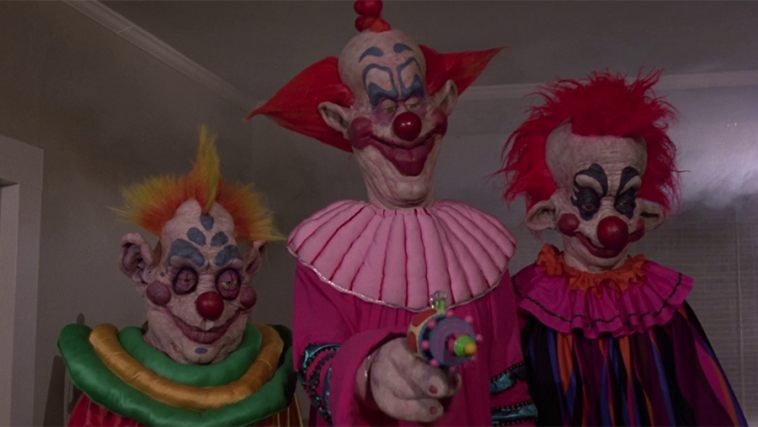 |
| Killer Klowns from Outer Space (1933), colourized |
Whenever someone comes to believe that their life is a cosmic joke, that they suffer and die for the amusement of a sadistic world, a cloyne is born. A gaudy giggling demon sustained by schadenfreude. The world is their stage and they perform only for their own entertainment, pushing mortals to pratfall straight to hell.
Wednesday, October 30, 2019
Another New New Crobuzon: Thaw
Not so long ago, less than the span of a generation, a great heathen army was raised in the north. A force like none living had seen, gathered by the promise of loot and glory to last until the end of the world. They set sail, set their many gods against one, and they were destroyed without ever setting foot on shore.
The humiliation resounded through their culture. Raiders became traders. Gilded swords were melted down for coinage, ships were gutted to fit more goods in their holds. What once was taken violently would now be won cunningly, or else another defeat would end them.
The seat of their power, the city called Thaw, opened its doors for business. Attractions were built, halls in imitation of their warrior-heaven on earth where mead flowed in waterfalls, saunas and bathhouses altered to southern tastes. Money came in, fortune raised some and tossed down others, resentment and contempt spread like a fresh bruise beneath the friendly shopfronts. Disgraced killers turn to poison and magics before thought unmanly, gods that forsook their charges in their time of need are called on with whips and curses in place of offerings.
Change came to Thaw, and change comes again, tasting like death all the while.
Three Minorities
Frost Giants: Steadfast allies of the northmen since time immemorial, whose ships of leviathan-bone went to their doom with the great heathen army. The giants took the defeat even harder. To them, it's the start of the world's dusk, a terrible and terminal cosmic decline. The majority retreated to glacial fastnesses in the uttermost reaches, there to remain in preparation for their role in the final battle, or sleep away in sea-caves to dream and sing with the whales. A few lost faith, lost themselves in drinking, gambling, whoring, and a few had their faith hardened, their blood and their hatred turned to ice. These latter giants seek new allies, once old enemies: the Sun-Eater Wolf, the Stitch-Lipped Liar, the Serpent Who Strangles Mountains, the Calming Lightning.
Locathah: Cold-blooded and glassy-eyed people of the seas around Thaw, long considered by the northmen to be their natural thralls. In the wake of the great heathen army's destruction, Thaw began to fear uprising by the locathah, as they lost much of the strength needed to keep the fish-folk in line. To preempt violent rebellion the locathah were decreed universally free, at least in theory, though in practice prejudice and disenfranchisement has caused them to remain third-class citizens, below even human and giant thralls, subsisting in the desperate margins of an otherwise increasingly prosperous society. Like the northmen the locathah too have slipped from many of their old ways and their old gods. These things have come to be understood as subservient to their new god, their liberator, who succeeded when all miracles before had failed
Valkyries: Thaw's heroes have died, and by turning away from the warrior's path Thaw has ensured that never again will more rise to the standards of the valkyries. They're out of a job. The consensus among their kind has been that if they cannot collect heroes, they will themselves become heroes. Of Thaw's sailors the valkyries sail the furthest. Of its hunters they hunt the direst prey. Of its conspirators who whisper of cutting down the merchant-princes and scourging the seas once more, they push the hardest in making this a reality. Beside this drive, a shared dread unites them. Their master is silent, the bridges to his realm burned, perhaps both consumed by the fleet-melting fire that rained on the day that Thaw was broken.
Three Monstrosities
Wendigos: The northmen may have softened, but the north itself remains as merciless as ever. People still go hungry, and the will to survive so often overpowers the taboo of eating one's own kin. Temptation festers, humanity withers away, and another wendigo screams with the wind. When they can be caught, they're put with others of their kind in the underground asylum called the Hungry Quarter, fed by the dumped offal of sacrifices and the few who still practice senicide. The wendigos of Thaw are not hated, nor pitied. All who've been truly hungry understand the choice they made, and all this far north have been truly hungry.
Salamanders: The city and the fields that feed it are kept unseasonably, inhabitably warm by an elaborate system of qanats and pipes, supplied by the hot springs of the nearby mountains. These hot springs in turn are fueled by the salamanders that swim in their depths. Their slithering young are the bane of many a bathhouse, and the adults play a key role in the folk magic tradition of the region. Take something you dearly love and burn it, they say, spread the ashes in the boiling waters, and the salamanders will come like fish to chum. They'll offer up some inhuman wisdom or treasure in return. It's whispered that the great heathen army itself was gathered by their prophecy.
Draugr: The drowned dead of the great heathen army don't rest peacefully on the ocean floor. They spit out silt, shake the crabs from their bones, and they wander. Some walk to the far shore they hoped to invade in life, a plague to seaside villages and monasteries. Many returned home. They're the unspoken danger of Thaw's harbour bay, a symbol to revanchists and an embarrassment to the merchant-princes. The draugr hold court among scuttled warships, snatch fishermen who don't keep to the old ways, drag foreign priests squealing beneath the waves, and watch old friends from beyond the edge of the lamp-light.
Links
The OG: https://githyankidiaspora.wordpress.com/2009/06/10/make-your-own-new-crobuzon/
Anne's challenge and Crobuzon: https://diyanddragons.blogspot.com/2019/10/new-new-crobuzon-city-of-stones-and.html
Other Crobuzons:
https://sorcerersskull.blogspot.com/2019/10/the-rolling-city-and-devil-sun.html
https://talesofthegrotesqueanddungeonesque.blogspot.com/2019/10/the-new-new-crobuzon-challenge.html
https://benignbrownbeast.blogspot.com/2019/10/the-city-of-emination-newer-crobuzon.html
The humiliation resounded through their culture. Raiders became traders. Gilded swords were melted down for coinage, ships were gutted to fit more goods in their holds. What once was taken violently would now be won cunningly, or else another defeat would end them.
The seat of their power, the city called Thaw, opened its doors for business. Attractions were built, halls in imitation of their warrior-heaven on earth where mead flowed in waterfalls, saunas and bathhouses altered to southern tastes. Money came in, fortune raised some and tossed down others, resentment and contempt spread like a fresh bruise beneath the friendly shopfronts. Disgraced killers turn to poison and magics before thought unmanly, gods that forsook their charges in their time of need are called on with whips and curses in place of offerings.
Change came to Thaw, and change comes again, tasting like death all the while.
Three Minorities
Frost Giants: Steadfast allies of the northmen since time immemorial, whose ships of leviathan-bone went to their doom with the great heathen army. The giants took the defeat even harder. To them, it's the start of the world's dusk, a terrible and terminal cosmic decline. The majority retreated to glacial fastnesses in the uttermost reaches, there to remain in preparation for their role in the final battle, or sleep away in sea-caves to dream and sing with the whales. A few lost faith, lost themselves in drinking, gambling, whoring, and a few had their faith hardened, their blood and their hatred turned to ice. These latter giants seek new allies, once old enemies: the Sun-Eater Wolf, the Stitch-Lipped Liar, the Serpent Who Strangles Mountains, the Calming Lightning.
Locathah: Cold-blooded and glassy-eyed people of the seas around Thaw, long considered by the northmen to be their natural thralls. In the wake of the great heathen army's destruction, Thaw began to fear uprising by the locathah, as they lost much of the strength needed to keep the fish-folk in line. To preempt violent rebellion the locathah were decreed universally free, at least in theory, though in practice prejudice and disenfranchisement has caused them to remain third-class citizens, below even human and giant thralls, subsisting in the desperate margins of an otherwise increasingly prosperous society. Like the northmen the locathah too have slipped from many of their old ways and their old gods. These things have come to be understood as subservient to their new god, their liberator, who succeeded when all miracles before had failed
Valkyries: Thaw's heroes have died, and by turning away from the warrior's path Thaw has ensured that never again will more rise to the standards of the valkyries. They're out of a job. The consensus among their kind has been that if they cannot collect heroes, they will themselves become heroes. Of Thaw's sailors the valkyries sail the furthest. Of its hunters they hunt the direst prey. Of its conspirators who whisper of cutting down the merchant-princes and scourging the seas once more, they push the hardest in making this a reality. Beside this drive, a shared dread unites them. Their master is silent, the bridges to his realm burned, perhaps both consumed by the fleet-melting fire that rained on the day that Thaw was broken.
Three Monstrosities
Wendigos: The northmen may have softened, but the north itself remains as merciless as ever. People still go hungry, and the will to survive so often overpowers the taboo of eating one's own kin. Temptation festers, humanity withers away, and another wendigo screams with the wind. When they can be caught, they're put with others of their kind in the underground asylum called the Hungry Quarter, fed by the dumped offal of sacrifices and the few who still practice senicide. The wendigos of Thaw are not hated, nor pitied. All who've been truly hungry understand the choice they made, and all this far north have been truly hungry.
Salamanders: The city and the fields that feed it are kept unseasonably, inhabitably warm by an elaborate system of qanats and pipes, supplied by the hot springs of the nearby mountains. These hot springs in turn are fueled by the salamanders that swim in their depths. Their slithering young are the bane of many a bathhouse, and the adults play a key role in the folk magic tradition of the region. Take something you dearly love and burn it, they say, spread the ashes in the boiling waters, and the salamanders will come like fish to chum. They'll offer up some inhuman wisdom or treasure in return. It's whispered that the great heathen army itself was gathered by their prophecy.
Draugr: The drowned dead of the great heathen army don't rest peacefully on the ocean floor. They spit out silt, shake the crabs from their bones, and they wander. Some walk to the far shore they hoped to invade in life, a plague to seaside villages and monasteries. Many returned home. They're the unspoken danger of Thaw's harbour bay, a symbol to revanchists and an embarrassment to the merchant-princes. The draugr hold court among scuttled warships, snatch fishermen who don't keep to the old ways, drag foreign priests squealing beneath the waves, and watch old friends from beyond the edge of the lamp-light.
Links
The OG: https://githyankidiaspora.wordpress.com/2009/06/10/make-your-own-new-crobuzon/
Anne's challenge and Crobuzon: https://diyanddragons.blogspot.com/2019/10/new-new-crobuzon-city-of-stones-and.html
Other Crobuzons:
https://sorcerersskull.blogspot.com/2019/10/the-rolling-city-and-devil-sun.html
https://talesofthegrotesqueanddungeonesque.blogspot.com/2019/10/the-new-new-crobuzon-challenge.html
https://benignbrownbeast.blogspot.com/2019/10/the-city-of-emination-newer-crobuzon.html
Wednesday, October 23, 2019
Tuesday, October 22, 2019
Monster Blender Part I: Monster Names
The idea behind the monster blender is: take a bunch of monsters, break them down to the building blocks of their names, appearances, lore, abilities, behaviour, etc., then combine all those pieces with a random generator into an entirely new monster.
I’ve had a couple larger generators stall recently because of how much time I had to sink into them before they came together into something lastingly fun & useful, so I’ll be breaking up the monster blender into parts and then putting them together when they’re all out.
At ~529,407,870 possible combinations this may already be my biggest generator yet.
Generator automator here: http://paperelemental.blogspot.com/p/list-to-html-generator.html
I’ve had a couple larger generators stall recently because of how much time I had to sink into them before they came together into something lastingly fun & useful, so I’ll be breaking up the monster blender into parts and then putting them together when they’re all out.
At ~529,407,870 possible combinations this may already be my biggest generator yet.
Generator automator here: http://paperelemental.blogspot.com/p/list-to-html-generator.html
Subscribe to:
Posts (Atom)